When the Plan Falls Apart and Grace Steps In

I’m someone who likes a plan.

I like a calendar that makes sense, a schedule that runs smoothly, and a to-do list that gets checked off in satisfying little boxes. My weeks usually have a rhythm. Work, coaching calls, podcast planning, errands, and home life. Nothing too strict, but predictable.

Last Wednesday night reminded me how quickly life can tear up even the best plan.

I woke my dog Nordy up to go potty before bed, and he couldn’t walk.

Two hours prior, everything was normal. Now suddenly, his back legs were completely paralyzed.

If you’ve ever had a pet you love, you know the feeling. Your stomach drops. Your brain starts racing. You’re trying to stay calm while fear and worry are running circles in your head.

This happened at 10:30 that night, so I called my vet’s emergency line. Thank the Lord he takes emergency calls, because I had no idea what else to do. He met me at his office, checked Nordy over, and started him on steroids, pain medication, and a muscle relaxer.

By morning, everything about my week had changed.

Appointments had to be rearranged. Work slowed down. My sleep disappeared. Vet visits started piling up. Treatments had to be discussed. Tests had to be considered. Every decision felt urgent and expensive.

And vet bills… they add up fast…including emergency costs, which aren’t cheap.

There were things I hadn’t even thought about before. Nordy can’t be left unattended right now. That means I can’t leave the house without him. It means things like mowing the yard now require hiring someone because I can’t be outside long enough to take care of it myself while watching him.

All the normal pieces of life have suddenly changed.

The schedule I had carefully mapped out? Gone.

My work plans for that week? Delayed.

Even basic things like sleeping through the night disappeared because when your dog is hurting and can’t move properly, you wake up constantly to check on them.

So I did what a lot of people do when they’re scared and exhausted.

I started researching.

Late at night. Early in the morning. Anytime I couldn’t sleep.

One thing kept coming up during my searches: acupuncture for dogs with spinal injuries or paralysis. It doesn’t work in every case, but sometimes it helps stimulate nerve response and recovery.

That little word “sometimes” was enough for me.

So, I started looking for veterinarians who practiced acupuncture.

The closest one I could find was about two hours away from where I live.

On Saturday, I sent them a message. They were already closed, but I figured I’d hear back sometime this week. Maybe I could get an appointment eventually.

Instead, they texted me and scheduled Nordy for the following Thursday.

It wasn’t ideal with the distance, but at least it was something. A direction. A possibility.

When the vet replied to confirm, he asked what time of day I preferred.

I told him the afternoon would work better since I live two hours away.

Then he asked where I lived.

I told him. Then the replies stopped.

About thirty minutes later, my phone rang. It was the person I had been texting with.

He said something that honestly stopped me in my tracks.

His daughter is the veterinarian. He was just taking calls. Then he said he had a proposition for me.

I had no idea what to think, but said, “ok?”.

He said she happened to be in my town that weekend for a horse show. If I could come to where she was, she would see Nordy that evening. He let me know it wouldn’t be done in a vet’s office. Treatment would be done right there in the horse stable. I had no problem with that!

I was thrilled and grateful!

Two hours away suddenly turned into right here.

No waiting days for the first appointment.

No long drive with a paralyzed dog in the car.

Just an unexpected door opening exactly when I needed it.

I sat there for a moment after that call, thinking about how strange life can be.

We make plans.

We plan our weeks. Our work. Our schedules. Our finances. Our routines.

Then something happens that we never could have predicted.

A phone call.

A diagnosis.

A sick pet.

A sudden expense.

A change that throws everything off track.

And yet sometimes, right in the middle of that chaos, something else shows up.

Grace.

I believe God was working that day.

Out of all the weekends, that vet’s daughter was in my town. Out of all the times to reach out, I happened to leave a message when I did. Out of all the ways that situation could have unfolded, the door opened in the exact place I already was.

Now Nordy has regular acupuncture appointments scheduled.

We don’t know yet how much recovery he’ll have. We’re hopeful. We’re taking it one step at a time.

My schedule is still upside down.

Work has been interrupted. Plans have been moved. Expenses have grown for the next few months in ways I didn’t expect.

Life feels a little chaotic right now.

But sometimes the best reminder of faith comes when the plan falls apart.

Because when everything is going smoothly, it’s easy to believe we’re the ones holding it all together.

Moments like this remind me that we’re not.

Right now, my focus is simple.

Take care of Nordy.
Trust the process.

Continue to help my clients.
Keep the faith.

And accept that sometimes the most meaningful stories start the moment the plan goes completely off script.

For those who are curious, yes, I am still seeing clients, just on a slightly different schedule right now. Sessions will be scheduled around Nordy’s treatment. If you don’t see a time on my schedule that works for you, reach out, and we’ll find a time that does work. I have also added a few Saturday time slots to accommodate.

For now, Nordy sits next to me in his stroller, where I can keep an eye on him while I work. He is truly my very loyal (and very spoiled) office assistant.

And yes, I’m still taking on new clients. So, if you’re going through a financial transition, feeling overwhelmed by money decisions, or just need someone to help you sort through the numbers and the stress that comes with them, please reach out.

Life may throw the schedule off sometimes.

But the work of helping people move forward with their lives and their finances keeps me going and will continue.

Divorce Starts Before the Paperwork

I remember the day that my ex-husband and I decided we were going to separate.

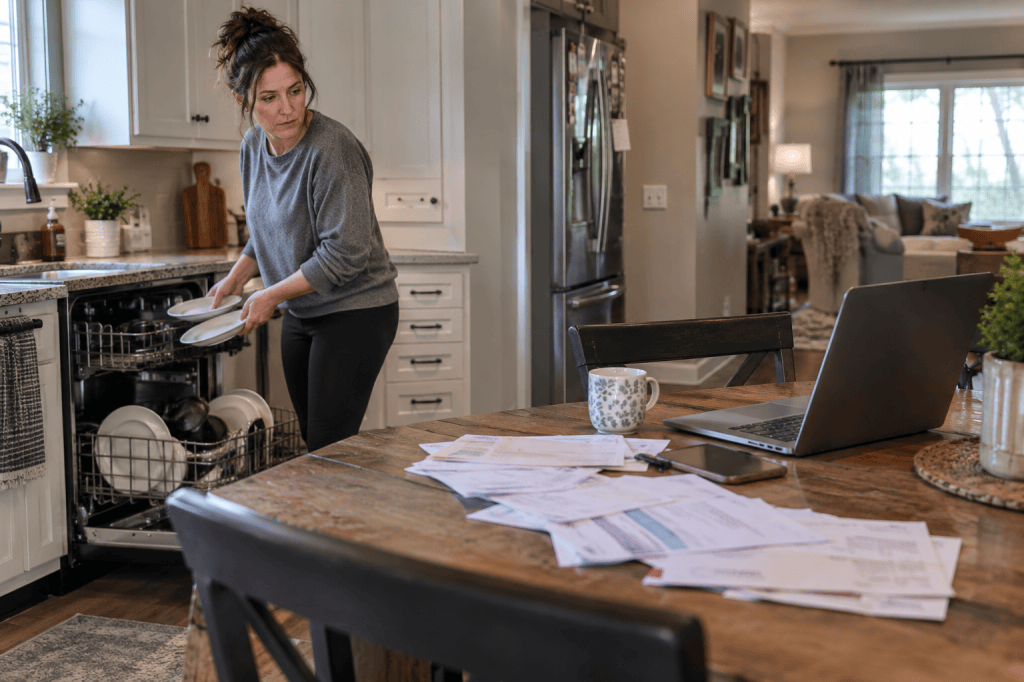
We were sitting at the kitchen table. The same table where we had celebrated birthdays. Paid bills. Helped with homework. Planned holidays.

But this time, we were planning the end of our marriage.

A few hours later, we sat the kids down and told them what was happening. I can still see their faces. Confused. Quiet. Trying to be brave because we were trying to be brave.

I had been a stay-at-home mom for 15 years.

Fifteen years of field trips, laundry, and packing lunches. Fifteen years of building my identity around being “Mom” and “wife.” And in one conversation, I wasn’t a wife and mom anymore.

I was about to become a single mom.

And the clock started ticking the moment we made that decision.

What most people don’t talk about is this: the hardest part of divorce often starts long before the papers are signed.

The moment you know it’s over, your brain goes into survival mode.

What about the kids?

Where are we going to live?
How am I going to afford this?
What about health insurance?
What about everything?

My ex-husband was in the military, which meant we were living on base housing. When we separated, that wasn’t an option anymore. I had to find a place for myself and the kids to live.

Fast.

I remember scrolling rental listings late at night after everyone was asleep. Doing math in my head that didn’t add up. Wondering how I was supposed to qualify for anything when I didn’t have an income yet.

And here was the reality I was facing – In the state we lived in, he wasn’t required to pay child support until the divorce was final.

Our divorce took 18 months.

Eighteen months of figuring it out on my own.

When you’ve been home for 15 years, you don’t just walk back into the workforce like nothing changed. You rebuild your confidence. You update a résumé that hasn’t been touched in years. You try to translate years of raising kids into something employers understand.

And you do it while your heart is breaking.

While your emotions are all over the place.

While your kids are asking hard questions.

You’re grieving the relationship.
You’re trying to stay strong for your kids.
You’re trying to make smart financial decisions while your whole world is in chaos.

Financial stress during divorce isn’t just about numbers. It’s about fear. It’s about the pressure of knowing people are depending on you.

It’s standing in the grocery store wondering if you should put something back.

It’s lying awake at night calculating rent plus utilities plus gas plus groceries over and over like somehow the total will change.

It’s trying to build a brand-new life while you’re still emotionally processing the old one ending.

No one hands you a manual for that.

That season forced me to learn how money actually worked in my life. Not the abstract version. The real version. The day-to-day decisions. The planning. The choices that determine whether you stay stuck or move forward.

I didn’t just learn how to survive financially. I learned how to take control of my financial life.

Because I know what it feels like to sit at the kitchen table staring at numbers that don’t make sense yet. I know what it feels like to carry the weight of trying to protect your kids while rebuilding your own life at the same time.

And I also know that with the right plan and support, things can become far more stable than they feel right now.

That experience is a big part of why I do the work I do today as a financial coach.

And here’s what I learned in that season, both as a woman walking through it and now as a financial coach helping others do the same:

  1. Clarity calms chaos.
    Even when the numbers are scary, knowing them is better than guessing. I wrote everything down. Every bill. Every expense. Every possible source of income. It didn’t fix it overnight, but it gave me something solid to stand on.
  2. Pride is expensive.
    I had to ask for help. I had to accept temporary work. I had to make decisions that weren’t glamorous but were necessary. Survival seasons are not the time for ego.
  3. Temporary doesn’t mean forever.
    That tiny rental? Temporary.
    That first job that wasn’t my dream? Temporary.
    That overwhelming fear? Temporary.

When you’re in it, it feels permanent. It isn’t.

  • You are more capable than you think.
    I didn’t feel strong. I felt terrified. Strength, I learned, is often just doing the next thing while shaking.

Divorce is emotional. It’s relational. It’s spiritual.

And it is deeply financial.

We don’t prepare women for that part. We tell them to “be strong.” We tell them “It will work out.” We rarely sit them down and say, “Let’s talk about cash flow, housing, income, legal timelines, and how to survive the 18-month gap.”

But that gap is where so much of the real battle happens.

Before the judge signs anything.
Before the paperwork is finalized.
Before the world sees you as officially divorced.

That in-between season is raw.

If you are going through a divorce, separation, or a major life transition and trying to figure out your finances in the middle of it, you don’t have to navigate that alone.

This is exactly the kind of season I help people through.

Together, we can look at where you are financially, create a clear plan for the next steps, and help you rebuild stability one decision at a time.

If that’s something you need right now, I’d love to work with you.

Reach out to schedule a free insight session to see if financial coaching is right for you.

More Money Won’t Fix This

It’s late. You told yourself you were going to go to bed early tonight… but somehow you ended up back on your phone, scrolling job listings.

“Better pay.” “Flexible schedule.” “Work from home.”

And for a second, it feels hopeful. Like, maybe this is the answer. Maybe this is how things finally get easier.

Because in your head, it makes sense: “If I just made more money, I wouldn’t feel this stressed all the time.”

So you keep looking.

But let me ask you something …

What if it’s not just about the income? Because most people don’t feel like they’re bad with money.

You’re not out here making huge, reckless decisions. You’re just… living.

Grabbing coffee because you’re exhausted. Ordering takeout because the day got away from you. Clicking “add to cart” because, honestly, it felt like you needed something good in your day.

None of that feels irresponsible. It feels normal because it’s not really about the money in those moments—it’s about how you feel.

Tired. Stressed. Overwhelmed. Frustrated.

And spending becomes the escape. A quick way to feel better, even if it’s just for a minute.

Then the month ends, and you’re left wondering where your money went.

So your brain jumps to the most obvious solution: “I need to make more.”

But here’s the thing: if the habits don’t change, more money doesn’t actually fix the problem. It just gives the pattern more room to grow.

I’ve seen it happen more times than I can count. People get the raise, land the new job, and somehow still feel just as tight, just as stressed, because no one ever showed them how much emotions play into money.

Or how to notice it. Or how to change it.

What if, instead of chasing another job right now, you got curious about your patterns?

Like,“What was I feeling right before I spent that?” or “What was I actually needing in that moment?”

Because those answers? They’re where the real change starts.

And once you see it, you don’t feel as out of control. You don’t feel as reactive. You don’t feel like your only option is to work more, earn more, push harder.

You start to feel a little steadier. A little more in control.

And those late-night job searches? They don’t feel quite as urgent anymore.

If you’re reading this and thinking, “Okay… that might actually be me,” you’re not crazy, and you’re definitely not alone. Because honestly? This also used to be me. “But now, this is exactly the kind of thing I help people untangle every day. So if that’s you, I’d love to sit with you in it and help you figure out what’s actually going on.

Let’s Chat

What If Your Spending Is Hiding in Plain Sight?

Have you ever looked around your home and thought, How did I end up with so much stuff?

But then another thought sneaks in.

Closets are full. Drawers barely close. The garage has boxes you forgot were even there. You start thinking maybe it’s time to downsize, declutter, or finally take a carload of things to donate.

Where did it all come from?

You don’t remember going on some massive shopping spree. You’re not walking around with twenty shopping bags every weekend. In fact, you probably think of yourself as a reasonable spender.

And yet, the evidence is sitting all around you.

The extra kitchen gadgets. The clothes with tags still on them. The random things from Amazon that seemed like a good idea at the time. The home décor you liked in the moment but never quite found a place for.

None of it felt like a big deal when you bought it.

That’s the interesting part about spending. Most people don’t get into trouble because of one huge decision. It’s the smaller purchases that slide into everyday life so easily you barely notice them.

A few clicks here.
A quick stop there.
Something small because it’s on sale.
Something else because it solves a tiny inconvenience.

Individually, each purchase feels harmless.

Collectively, they start filling your house.

I see this pattern often when I talk with people about money. They make good incomes. They’re responsible in many areas of life. But when we start looking at their finances together, one question keeps coming up.

Where is all the money going?

The answer usually isn’t dramatic. There’s no secret gambling habit or wild luxury lifestyle hiding in the background. It’s usually something much more ordinary.

Unnoticed spending.

The kind that blends into daily life so well that it never raises a red flag in your mind. Until one day you’re standing in your living room wondering why every shelf, cabinet, and closet feels a little crowded.

Your home quietly tells the story your bank account has been telling all along.

Most people have never been taught how to really observe their spending patterns. Money leaves the account in small pieces, and life moves quickly enough that we rarely pause long enough to connect the dots.

But when people start paying attention, they often realize the problem was never their income. It was awareness.

Once you begin noticing where money is flowing, you start making different choices without forcing yourself into some strict, miserable budget. You simply become more intentional.

You pause before the impulse purchase.

You recognize the difference between something you truly want and something that just caught your attention for a moment.

And strangely enough, the house starts feeling a little lighter too because things stop quietly accumulating without your permission.

So if you’ve ever looked around your home and wondered how everything multiplied when you weren’t paying attention, you’re not the only one.

Sometimes the clutter in our spaces is simply a reflection of the places in our finances where we stopped looking.

The good news is that once you start paying attention again, both can change a lot faster than most people expect.

If any of this sounds familiar, it might be time to take a closer look at what’s really happening with your money.

Most people don’t have a spending problem because they lack discipline. They simply haven’t had someone help them slow down, look at the patterns, and connect the dots.

That’s exactly what I do.

I work with people who make good money but still find themselves wondering where it all goes. Together, we look at your habits, your spending patterns, and the small decisions that quietly shape your finances. Once you start seeing things clearly, the changes become much easier than most people expect.

If you’re curious about what your own patterns might reveal, I’d love to help.

Reach out and let’s start the conversation.

Let’s chat

The Real Cost of the Way I Was Spending

A few years ago, I had one of those quiet moments that sneaks up on you.

I was just sitting at my kitchen table with my coffee, scrolling through my bank account. And this thought crossed my mind:

How am I still here?

I had a professional job. A good one. The kind people assume means you must have your life together. I was making good money. I dressed the part, drove a fun car, and had a nice apartment. From the outside, it probably looked like things were going pretty well.

And if I’m being honest, part of me worked really hard to keep that image going.

The clothes had to look right. The car had to look right. Meeting friends for dinner, fun little shopping sprees, and picking up things here and there that made life look a little more polished. It all felt like part of the package of being a successful professional.

But sitting there at that table that morning, staring at my bank account, the truth was hard to ignore.

For someone who supposedly had it together, my money didn’t look like it.

Every month felt the same. My paycheck would come in and, before long, it felt like it had quietly slipped through my fingers. Nothing outrageous or reckless. Just spending here and there that added up faster than I ever expected.

And I kept telling myself the same thing.

Next month I’ll get serious.

Next month I’ll pay closer attention.
Next month I’ll start saving.
Next month I’ll get it together.

But next month kept coming and going.

As I sat there that morning, I started realizing something that made me a little uncomfortable.

A lot of what I was spending money on wasn’t even making me that happy.

It was maintaining a picture.

The picture of someone who was doing well. Someone who had the right things, the right lifestyle, the right look. And the strange part was that no one had really asked me to keep up that image. I had created it myself.

Meanwhile, the things I said I wanted: peace with my money, a sense of security, not feeling that little knot in my stomach when I looked at my bank account, those things were always getting pushed to “later.”

And the truth finally landed.

I had been saying I wanted financial freedom, but I wasn’t willing to give up the habits that were standing in the way of it.

Oh, I knew better. But I had gotten comfortable living a certain way.

The dinners out were easy.
The random shopping trips were fun.
Telling myself I needed to look a certain way felt important.

Sacrifice, on the other hand, sounded uncomfortable.

But sitting there that morning, I had to admit something to myself. The way I was living wasn’t really making me happy anyway.

It looked good from the outside. That’s about it.

And that’s when the question hit me.

What do I want more?

Do I want to keep maintaining this image, or do I want the peace I keep saying I want?

I had to face the fact that you can’t keep doing the same things with your money and expect your financial life to look different one day. Something has to change.

So I started making some adjustments. Nothing extreme.

I chose to cut back on the extras, and it wasn’t because I suddenly stopped liking nice things. It was because I realized I liked the idea of peace more. I wanted to stop living paycheck to paycheck. I wanted to stop the cycle of “I’ll start next month.” And that meant letting go of a few habits that were keeping me stuck right where I was.

At first it felt strange. Like I was stepping away from a version of myself I had been playing for a while.

But over time something unexpected happened.

The pressure lifted.

I stopped feeling like I had to keep up with some invisible standard. I started paying attention to my money in a way I hadn’t before. And for the first time in a long time, I felt like I was actually in control of it.

That’s when I realized something.

Sacrifice isn’t really about giving things up. It’s about deciding what actually matters to you.

For me, it turned out that peace mattered more than appearances.

And the version of me who eventually built a healthier financial life didn’t live the same way the old version did. She thought about her spending. She paused before saying yes to things that used to be automatic.

It wasn’t because I couldn’t afford them.

It was because I finally understood what they were costing me.

And once you feel the relief of not constantly worrying about money, something becomes very clear.

The real sacrifice wasn’t cutting back on things.

The real sacrifice would have been continuing to live a life that looked good on the outside but didn’t feel good on the inside.

I now drive a sensible car. I moved out of my apartment and could finally afford a house. My clothes are still cute but way more comfortable.

The sacrifice of getting here was temporary.  But the peace I have in my life will last beyond the material things I once tried to find it in.

What If This Is the Moment?

There’s a question most people don’t ask themselves out loud:

How comfortable am I in my own misery?

It’s a hard question to answer because answering it honestly tells you how ready you are for change.

If you’re not sure what your answer is, you can figure it out in a simple way.
Ask yourself this. “How long am I willing to complain or worry about my situation before I decide something different is available to me?”

That is your answer.

I hear people say all the time that they are tired of being stressed about money. They are tired of living paycheck to paycheck. They are tired of feeling behind, tired of arguing about finances, tired of not knowing where their money is going.

And yet, months go by. Sometimes years. Their situation stays the same.

At some point, we have to be honest about what is really happening. The situation might be uncomfortable, but it has also become familiar. And familiar has a way of feeling easier than change.

There is a version of financial stress that people learn how to live with. They know the feeling of checking their account and hoping for the best. They know the tension when a bill comes in. They know the anxiety that is ever-present in everyday life.

It is not that they enjoy it. It is that they have gotten used to it.

Change asks more of you. It asks you to look at your numbers when you would rather avoid them. It asks you to make decisions you have been putting off. It asks you to have conversations that feel uncomfortable. It asks you to take responsibility in a way that can feel confronting.

So instead, many people stay in the cycle because it feels easier than stepping into something unknown.

There’s something we don’t want to admit, even to ourselves. Staying the same has a cost. Every month that passes without a clear plan, without new habits, without any real action, you are paying for that comfort. You may not see it all at once, but it shows up over time. It shows up in stress that never fully goes away. It shows up in missed opportunities. It shows up in the feeling that life could be different, but somehow never is.

There is a moment that changes everything, and it is not when you learn something new about money. Most people already know enough to do better. The change happens when you decide you are no longer willing to stay where you are.

Not because someone told you to change. Not because you feel guilty. But because you are done having the same conversation with yourself over and over again.

That decision is where real financial change begins.

From there, it becomes less about motivation and more about honesty. Looking at what is actually happening with your money. Making choices that reflect what you say you want. Following through even when it feels inconvenient.

Most people get stuck, not from a lack of information, but in the gap between knowing and doing.

This is where financial coaching matters. Not as someone who tells you what you already know, but as someone who helps you see what you have been avoiding that you might not even realize. Someone who helps you put structure around your goals and stay consistent when old patterns try to pull you back.

You know you can stay in the same place for a long time if you are willing to tolerate it.

The real question is how long you plan to.

At some point, you have to decide if you are more comfortable staying in the problem or stepping into the discomfort that comes with changing it.

One keeps you where you are.
The other moves your life forward.

You Can Afford It. But What Is It Costing You?

Captured in the dawn, the tree was enlightened by the rising sun. This moment was caught nearby Lake Chiemsee, Bavaria

What if the “dream” you’ve been chasing is the very thing making you tired?

Not physically tired. Soul tired.

The kind of tired where your calendar is full, your car payment is impressive, and your bank account still makes you a little excited when you open the app.

We were handed a script somewhere along the way. Work hard. Earn more. Upgrade often. Bigger house. Nicer car. Better vacations. Rinse and repeat. And if your neighbor adds a patio, apparently that means you need one too.

Keeping up with the Joneses has turned into an Olympic sport, and most of us are competing in events we didn’t realize we signed up for.

Here’s the honest question. Is it actually making you happy?

I’ve sat with enough people in financial transition to tell you this. The stress rarely comes from not having enough stuff. It comes from having too many obligations. Too many payments. Too many things that looked good on the outside but little by little stole peace on the inside.

Some of you don’t need a raise. You need relief.

Living more simply doesn’t mean selling everything and moving into a tiny cabin in the woods (unless you really want to). It means asking a braver question. What do I actually value?

Do you value margin in your bank account or matching patio furniture? Do you value unhurried dinners at home or the image of being “busy and important”? Do you value freedom or financing?

Jesus talked a lot about this, which I find interesting. In Matthew 6:21 He says, “For where your treasure is, there your heart will be also.” Not where your intentions are. Not where your Pinterest board is. Where your treasure is.

If your treasure is tied up in appearances, your heart is going to feel stretched thin trying to maintain them and empty trying to convince yourself they have purpose.

I’ve watched clients breathe differently when they decide to simplify. When they downsize the house that felt impressive to friends but heavy to own. When they trade the luxury SUV for something reliable and easier to pay off. When they stop saying yes to every trip, every event, every upgrade, just to prove they can.

At first, it feels like you’re “losing.” Your pride might whine a little. You might worry about what people will think.

Then something surprising happens.

You sleep better.

You check your bank account without that spike of adrenaline.

You start making decisions from intention instead of insecurity.

Living more simply financially can look like fewer monthly payments. A smaller mortgage. A car you actually own. A budget that reflects your real priorities instead of your social media feed. It can look like choosing experiences that matter over optics that impress.

It can also look like finally admitting that the dream you were chasing wasn’t even yours.

Sometimes the “dream life” is just a well-marketed version of someone else’s vision.

Peace, though? That’s personal.

I think about the years in my own life where I was rebuilding. Working multiple jobs. Counting every dollar. I didn’t have the dream house (not even A house) or the polished image. What I did have was clarity. I knew what mattered. My kids. Stability. Faith. A future that didn’t feel like it was balancing on a credit card statement.

Strangely, those were some of the most grounded years of my life. It’s funny how now that I “have it all” I yearn for parts of those days and am actively working to simplify my life again.

There’s a verse in 1 Timothy 6:6 that says, “Godliness with contentment is great gain.” Not Godliness with a side of granite countertops. Just contentment.

Contentment isn’t complacency. It’s confidence. It’s knowing you don’t need to perform financially for anyone else. It’s trusting that provision doesn’t have to come wrapped in comparison. I’m not saying you should give up your job and live like a pauper. What I’m saying is maybe it’s time to reevaluate your lifestyle and what you’ve made important.

If you finally got what you wanted and it still feels like something is missing it could be that you built around expectations instead of convictions.

Living more simply could mean fewer things and more margin. Fewer payments and more generosity. Fewer comparison spirals and more gratitude. It could mean your money finally supporting your life instead of your life constantly trying to support your money.

And that changes everything.

Maybe the goal isn’t to impress the Joneses.

Maybe the goal is to sit at your own table, in your own home, with people you love, and feeling peaceful.

That sounds like a dream worth chasing.

What Are You Hiding (About Your Money)?

Can I ask you something a little uncomfortable?

What are you hiding about your finances?

Not the “we’re fine” version. Not the “inflation is crazy” deflection. I mean the real thing. The thing you don’t say out loud. The thing you quickly change the subject from.

Are you embarrassed of the debt you’ve brought on yourself? Not just that you have it, but that you know exactly how you got it?
Do you swipe and then quietly hope nobody notices?
Do you move money around between accounts just to make it all look… fine?

Are you secretly dreaming of a life where you’re not living paycheck to paycheck—but you’d never admit that to anyone because you make decent money, because other people have it worse, and someone might say, “Well, you should’ve made better choices”?

I want you to sit with that for a minute.

Because a lot of people are walking around looking financially “normal” on the outside while carrying a whole lot of private stress on the inside.

Here’s what I’ve learned, both in my own life and walking with clients through theirs:

It’s not just the debt that weighs on people.
It’s the secrecy.

You go to dinner with friends and split the bill evenly, even though you ordered the cheapest thing on the menu.
You say yes to the trip because you don’t want to be the only one who can’t afford it.
You nod along in conversations about investing and retirement, hoping no one asks you a direct question about how yours is doing.

And then you go home and feel that tightness in your chest.

You tell yourself you should know better by now. You’re smart. You’re capable. You’ve read the books. You’ve listened to the podcasts. You’ve watched the reels. So why does your real life still feel like you’re one unexpected expense away from panic?

Let’s talk about the mental health side for a minute.

There’s a deep shame that comes with money. Especially when the debt feels self-inflicted. Especially when the spending was emotional. Especially when you know the Amazon boxes weren’t about “needing” anything at all.

And then Sunday morning rolls around, and you’re sitting in church, singing about trust… while low-key avoiding your finances.

You love God.
You believe He provides.
But you also know you ordered those shoes.

Both things can be true.

There’s this hidden guilt people carry that says, “If I were more disciplined… more faithful… more mature… I wouldn’t be here.”

That’s not conviction. That’s condemnation. And those are not the same thing.

Conviction nudges you toward change.
Condemnation just keeps you hiding. And hiding is exhausting.

And now you’re stuck with the bill and the story you tell yourself about what that means.

Maybe you’ve even started hiding purchases from your spouse. Or downplaying the balance. Or telling yourself it’s “not that bad” while avoiding the actual number.

Or maybe your secret isn’t debt.

Maybe your secret is that you make good money… and still feel behind.

Maybe your secret is that you’re tired of pretending you’re fine.
Tired of acting grateful for a job that drains you.
Tired of saying “we’re doing okay” when you haven’t felt steady in years.

Or maybe your secret is bigger.

Maybe you want a different life.
A slower one.
A lighter one.
One where you’re not constantly calculating and recalculating and hoping the math works.

But you don’t say that out loud because people might think you’re foolish. Or unrealistic. Or irresponsible for wanting more peace.

So you keep it to yourself.

Here’s what I’ve learned, from my own messy money seasons and from walking with so many of you through yours:

The secret is heavier than the debt.

The pretending is more exhausting than the budgeting.

And the silence? That’s what keeps people stuck.

There is something powerful that happens the moment you tell the truth. Even if it’s just to yourself. Even if it’s whispered.

“I don’t like how this feels.”
“I’m scared.”
“I want something different.”
“I don’t know how to fix this.”

That doesn’t make you foolish. It makes you honest.

And honesty is where change begins.

Money struggles don’t mean you’re bad with money. They often mean you were coping. Surviving. Trying. Learning without a roadmap. Making decisions with the tools you had at the time.

But you don’t have to keep carrying the secret alone.

So let me ask you again, gently this time—

What are you hiding about your finances?

And what would happen if you stopped hiding?

What would it feel like to bring it into the light? To look at it clearly. To stop judging yourself long enough to actually build something better?
You don’t need to have it all figured out.
You just need a moment of courage.

Because the life you quietly dream about, the one where you feel steady, clear, and in control, isn’t reserved for “other people.”

It starts the day you decide the secret doesn’t get to run the show anymore.

The Most Frustrating Part of Fixing Your Finances (That No One Talks About)

There’s a stage of financial growth that doesn’t get celebrated, posted, or talked about much.

It’s the season where you’re trying. Really trying. You’re more aware, more careful, more intentional… but the results feel small and slow. You keep showing up, yet the big changes still seem just out of reach.

That’s the season where patience starts to wear thin.

It’s the waiting.

Not the soothing, inspirational poster with rocks perfectly balanced in a stack next to a flowing river, talking about patience, kind of waiting. I’m talking about the kind where you check your bank app again even though you already know what it says. The kind where you’ve been “doing better” for months and your life still doesn’t look like a money makeover show.

Working on your finances asks for a level of patience that feels almost rude.

You start out motivated. New budget. Fresh goals. Maybe even a color-coded spreadsheet that makes you feel like the CEO of your own life. You’re ready. You’re focused. You’re finally dealing with the stuff you used to avoid.

Then reality strolls in like, “Oh, you wanted progress? That’ll be delivered in small, unimpressive installments over a long period of time.”

Rude.

The hard part is that financial change doesn’t usually come with fireworks. It comes with tiny decisions that feel boring and repetitive. Packing lunch. Logging into your account. Saying “not this time” to something you really want. Moving a little money to savings and trying not to laugh at how small the number looks.

You’re doing the right things, but your feelings are over there tapping their foot like, “Are we rich yet or what?”

This is where patience starts to feel less like a virtue and more like a test of character.

There’s a scripture that comes to mind in Galatians 6:9 about not getting tired of doing good, because in the right season you’ll reap a harvest if you don’t give up. That sounds lovely stitched on a pillow. In real life, it feels more like, “Lord, I am doing the good. I would now like the harvest. Preferably by Friday.”

But money growth follows seasons, not moods. And seasons don’t rush because we’re uncomfortable.

One of the sneakiest things that makes patience harder is comparison. You’re over here, proud that you didn’t overdraft this month, and someone else is posting closing photos in front of a new house with a giant bow on the door. You’re celebrating a paid-off credit card, and somebody else is on a beach talking about “soft life.”

It can make your steady progress feel small, even when it’s taking real effort and courage. You don’t see their backstory, their help, their debt, their stress, or their timing. You just see the highlight reel while you’re in the middle of your training montage.

And let’s be honest, the middle is not glamorous.

The middle is where you’re tired of thinking about money but still have to. It’s where an unexpected car repair shows up like an uninvited guest and eats the money you just saved. It’s where you wonder how you can be trying this hard and still feel like you’re only inching forward.

That’s usually when the old thoughts creep in. “I should have figured this out sooner.” “Why does this feel so hard?” “I’m never going to get where I want to be.”

That spiral can make you want to quit, not because you don’t care, but because you care so much and you’re worn out. Patience feels impossible when you’re emotionally tired.

This is where grace and grit have to team up.

Grace says you’re allowed to be learning. Grit says you’re still getting up tomorrow and making the next wise decision anyway. Even if that decision is small. Even if it’s just paying one bill on time, skipping one impulse buy, or looking at what you owe with honesty instead of pushing the thought away.

Small faithfulness doesn’t feel impressive, but it builds a life that feels steady.

Another verse that fits here is from Proverbs 21:5 about how steady plodding brings prosperity. Plodding is not a glamorous word. Nobody ever says, “I’m just out here plodding my way to financial peace!” But that’s exactly what it often looks like. Slow steps. Repeated choices. Not dramatic. But very effective.

And somewhere in the middle of all that plodding, something starts to change.

You notice you pause before spending. You feel a little less panic when a bill hits. You actually know what’s in your account. You recover from setbacks a bit faster than you used to. Your numbers may not be where you want them yet, but your relationship with money is changing. That’s huge.

Patience with money isn’t about pretending the wait is easy. It’s about deciding the future you’re building is worth the slow, sometimes frustrating process of getting there.

So if you’re in the thick of it, doing the unglamorous work, wishing progress would hurry up already, remind yourself that you’re in the part that builds strength, wisdom, and staying power.

And one day, you’ll look at your life and realize the season that felt the longest was the one that laid the strongest foundation.

Also, when that day comes, you have full permission to look at your bank account, smile, and say, “See? I told you we were getting somewhere.”

Show Me Your Bank Account, and I’ll Show You Your Priorities

We all have a list in our heads.

Family. Faith. Freedom. Health. Peace. Security. Growth. Legacy.

If I asked you what matters most to you, you wouldn’t hesitate. You’d answer with confidence from the heart. And I would believe you.

But if you slid your bank statement across the table…
I’d learn something else too.

Not because you’re lying.

But because money keeps a record of what we actually choose.

Your bank account isn’t trying to teach you a lesson.
It simply tells the truth.

And sometimes, that truth is uncomfortable.

The Gap Between Values and Behavior

Most people don’t struggle with values.
They struggle with alignment.

We say we value:

  • Financial peace, but live paycheck to paycheck..
  • Family time, but buy convenience instead.
  • Freedom, yet finance everything.
  • Health, but ignore our own care.
  • Growth, but we rarely invest in learning or getting help.

Again, this isn’t about shame.
It’s about awareness.

Because money follows behavior.
And behavior follows habits.
And habits often operate without permission from our values.

Your bank account is a mirror.

It reflects what felt urgent.
What felt comforting.
What felt necessary in the moment.

And what felt easier than sitting with discomfort.

Spending Is Emotional, Not Logical

We like to pretend we are rational with money.

We are not.

We spend when we are tired.
We spend when we are bored.
We spend when we are stressed.
We spend when we are trying to feel something.

Sometimes we spend to celebrate.
Sometimes we spend to numb.
Sometimes we spend to belong.
Sometimes we spend to escape.

Your bank statement doesn’t just show transactions.
It shows emotional patterns.

It shows where you run for relief.
It shows what makes you feel safe.
It shows what you use to cope.

And once you see that, you can’t unsee it.

The Story Money Is Telling About You

Imagine your bank account could talk.

It might say:

“I value convenience more than rest.”
“I value comfort more than margin.”
“I value appearances more than peace.”
“I value quick relief more than long-term stability.”
“I value survival over strategy.”

Or it might say:

“I value preparation.”
“I value choice.”
“I value future me.”
“I value flexibility.”
“I value alignment.”

Neither story makes you a good or bad person.

But one story gives you options.
The other quietly removes them.

Priorities Aren’t What You Claim — They’re What You Fund

If something truly matters to you, it shows up in one of three places:

  1. Your calendar
  2. Your energy
  3. Your money

When all three agree, life feels grounded.

When they don’t, life feels heavy.

You can say you want financial freedom, but if every dollar is assigned to comfort, distraction, and reaction, freedom stays theoretical.

You can say you want peace, but if your spending creates pressure, peace stays distant.

You can say you want growth, but if nothing is invested in learning, growth becomes wishful thinking.

This isn’t about cutting joy.

It’s about deciding what kind of joy you want later.

Why This Feels Personal

Money touches everything:

  • How you sleep
  • How you argue
  • How you dream
  • How you choose
  • How you feel about yourself

That’s why conversations about money often feel like conversations about worth, security, control, and identity.

You aren’t just managing numbers.

You are managing your relationship with safety.

So when I say, “Show me your bank account,” what I’m really saying is:

Show me what you protect.
Show me what you fear.
Show me what you trust.
Show me what you avoid.
Show me what you believe about yourself.

The Quiet Power of Alignment

Alignment doesn’t require perfection.

It requires honesty.

Alignment is when your money begins to reflect who you are becoming, not just who you have been.

It’s when you pause before spending and ask,
“Does this support the life I say I want?”

It’s when you stop treating future-you like a stranger.

It’s when your values stop living only in words and start living in the numbers.

Alignment is peaceful.

Even when the numbers are small.

Even when progress is slow.

Because direction matters more than speed.

The Hardest Truth

If your bank account doesn’t match your values, it doesn’t mean you lack discipline.

It often means you lack clarity.

Most people were never taught how to connect values to spending.

They were taught how to earn.
They were taught how to swipe.
They were taught how to survive.

They were rarely taught how to choose.

You Don’t Need a New Budget. You Need a New Conversation.

Not a spreadsheet conversation.

A values conversation.

A “what kind of life do I actually want to fund” conversation.

A “what am I willing to delay for something better” conversation.

A “what am I tired of pretending doesn’t matter” conversation.

Because once your values are clear, the numbers become easier.

Not easy.

But clearer.

A Gentle Challenge

Pull up your last 30 days of spending.

Don’t judge it.
Don’t explain it.
Don’t justify it.

Just observe it.

Then ask:

What does this say I care about?
What does this say I avoid?
What does this say I protect?
What does this say I prioritize?

You may discover that your money isn’t betraying you.

It’s just telling you where you’ve been living on autopilot.

And autopilot can be changed.

This Is Where Real Financial Peace Starts

Not with restriction.

Not with guilt.

Not with comparison.

But with awareness.

When you see your money clearly, you gain choice.

And choice is where peace begins.

Final Thought

Your bank account is not your enemy.

It is your most honest feedback partner.

It shows you where your life is currently funded.

And it quietly invites you to decide if that still fits who you are becoming.


Reflection Question:
If your bank account had to explain your priorities to someone who’s never met you, would you feel proud of the story it tells or want to rewrite it?

If you’re ready to rewrite it, start with one small, honest shift. One choice that supports the life you actually want to live. And let that be enough for today.

If you’d like help making your money match the life you actually want, I’d love to support you. You can schedule a conversation with me when you’re ready.

You can even do a one time jump start session to get you going in the right direction dhttps://meetings.tulincu.com/public/693db1c6538dba003187eb5d