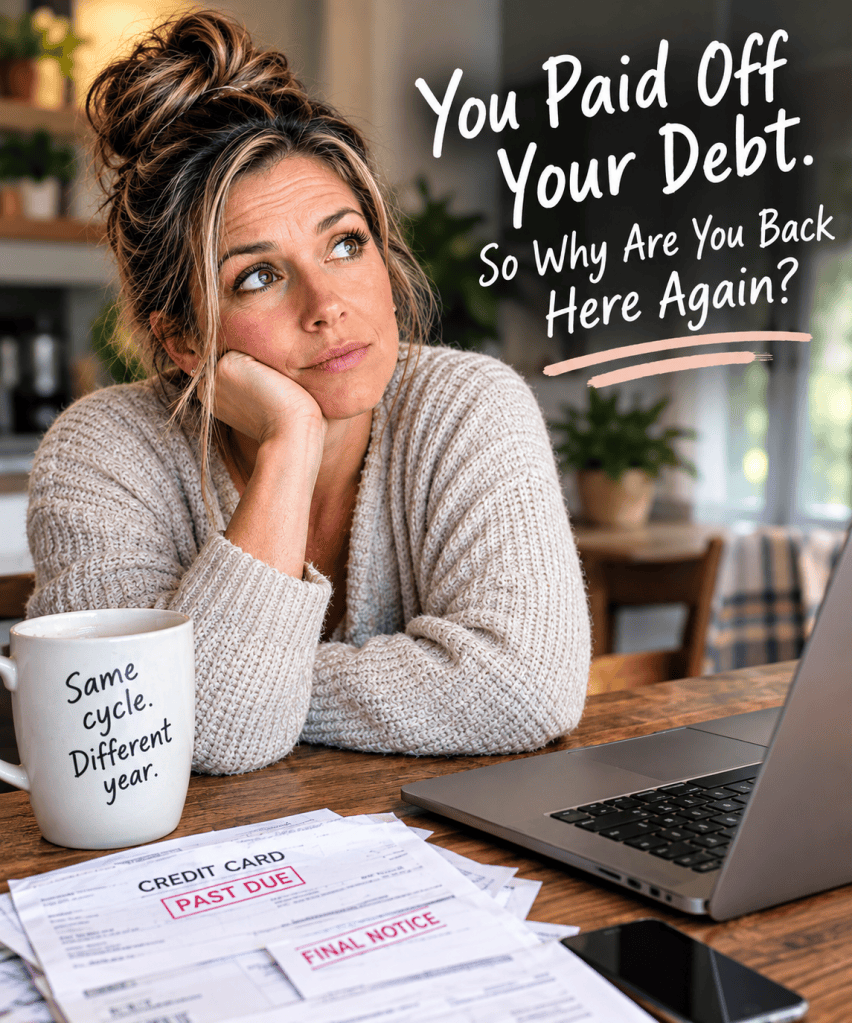
Even if you’re not someone who officially makes New Year’s resolutions, there’s something about the end of the year that gets us thinking.
Maybe you’ve caught yourself thinking about things you’d like to change. You’d like to take better care of yourself. Get more organized. Spend less. Save more. Finally get a handle on your finances.
Maybe this is the year you promise yourself things are going to be different. You’ll start fresh in January. You’ll get serious about your money. You’ll stop wondering where your paycheck went before the next one arrives. You’ll make a plan and stick to it.
And maybe you really will.
But here’s a thought. What if you didn’t have to wait until January 1st to start feeling better about your finances?
What if you could begin making changes now, so that when the new year arrives, you’re not starting from scratch and you’re already moving in the direction you want to go.
Think about what that could feel like.
Let’s talk about the holidays for a minute.
For some of us, the holidays bring excitement, family traditions, and memories we look forward to making.
They can also bring a fair amount of financial stress.
There’s the gifts to buy, the extra groceries, the family gatherings, the travel, the school activities, the decorations, and all those little extras that somehow add up to a whole lot of money.
You want to make Christmas special. You want to give your family a wonderful holiday. You want to say yes when the kids or grandkids want to do something fun. And wouldn’t it be nice to look at your bank account in January and not wonder how things got so out of hand?
Most of us have been there before. You tell yourself you’ll keep spending under control this year. You have great intentions. You might even have a budget. But then something comes up (like it usually does). You see the perfect gift. Someone invites you to an event. You decide to splurge a little because it’s Christmas, after all. And before you know it, you’re spending more than you planned.
The credit card balance creeps up. The savings account takes a hit. And somewhere in the back of your mind, you’re already worrying about how you’re going to make everything work once the holidays are over.
That’s a lot to carry while you’re supposed to be enjoying the season.
Now, imagine approaching the holidays a little differently. Imagine knowing how much you can comfortably spend, having a plan for the expenses you know are coming, and being able to make decisions without that constant mental calculation of Can I afford this? What happens if I buy that? Will I regret this later?
You may still have some financial decisions to make because life doesn’t suddenly become predictable just because we have a plan. But wouldn’t it be nice to feel more in control of those decisions?
You don’t have to overhaul your entire financial life before Christmas.
I’m not suggesting you need to spend the next few weeks creating a strict budget, cutting every extra expense, and becoming a completely different person before the holidays arrive. That’s a lot of pressure to put on yourself.
Instead, what if you started with a few small things? Take an honest look at where your money is going. Figure out what you can comfortably spend on the holidays. Think about the expenses coming in January that might get overlooked when you’re caught up in the excitement of December.
And pay attention to the things that tend to throw you off course. Maybe it’s the last-minute shopping. Maybe it’s feeling guilty when you can’t give someone what you’d like to give them. Maybe shopping is one of the ways you reward yourself after a stressful week.
Understanding what’s happening is just as important as figuring out the numbers. Most of us know we should save more or spend less. But sometimes there’s more going on beneath the surface, and a budget alone doesn’t address it. The goal is to understand your patterns and begin making choices that support the life you want to live one decision at a time.
Now, imagine walking into January differently.
Instead of waking up on January 1st with a list of resolutions and the same financial worries you’ve been carrying for months (or years), imagine already having a little momentum.
Think about how it would feel if you’ve already started paying attention to your spending, made some decisions about your priorities, and have a better idea of what’s happening with your money and what needs to change.
Maybe you’ve even discovered that a few small adjustments make a bigger difference than you expected. And you didn’t have to wait for a particular date on the calendar to give yourself permission to do it.
You can start right where you are, with the money you have, the circumstances you’re facing, and the next decision in front of you.
And maybe the biggest difference you’ll notice isn’t even the number in your bank account. Maybe it’s the relief of not feeling quite so anxious when you think about money. The confidence that comes from knowing what’s happening with your finances. The ability to enjoy the holidays without carrying so much worry into every purchase.
Wouldn’t it be wonderful to enter the new year with a little more clarity, a little more confidence, and a little more peace?
You don’t have to wait until January to begin creating that. You can give yourself that head start today. And you deserve to enjoy the holidays while you’re doing it.
Let me ask you something.
If you could change just one thing about your financial life before the new year arrives, what would it be?
Would it be feeling less anxious about money? Knowing where your money goes? Getting through the holidays without adding to your debt? Or finally feeling like you’re making progress toward something that matters to you?
I’d love to hear what’s on your mind.